11. May 2023
The invisible threat: Microplastics from the ocean end up on your plate
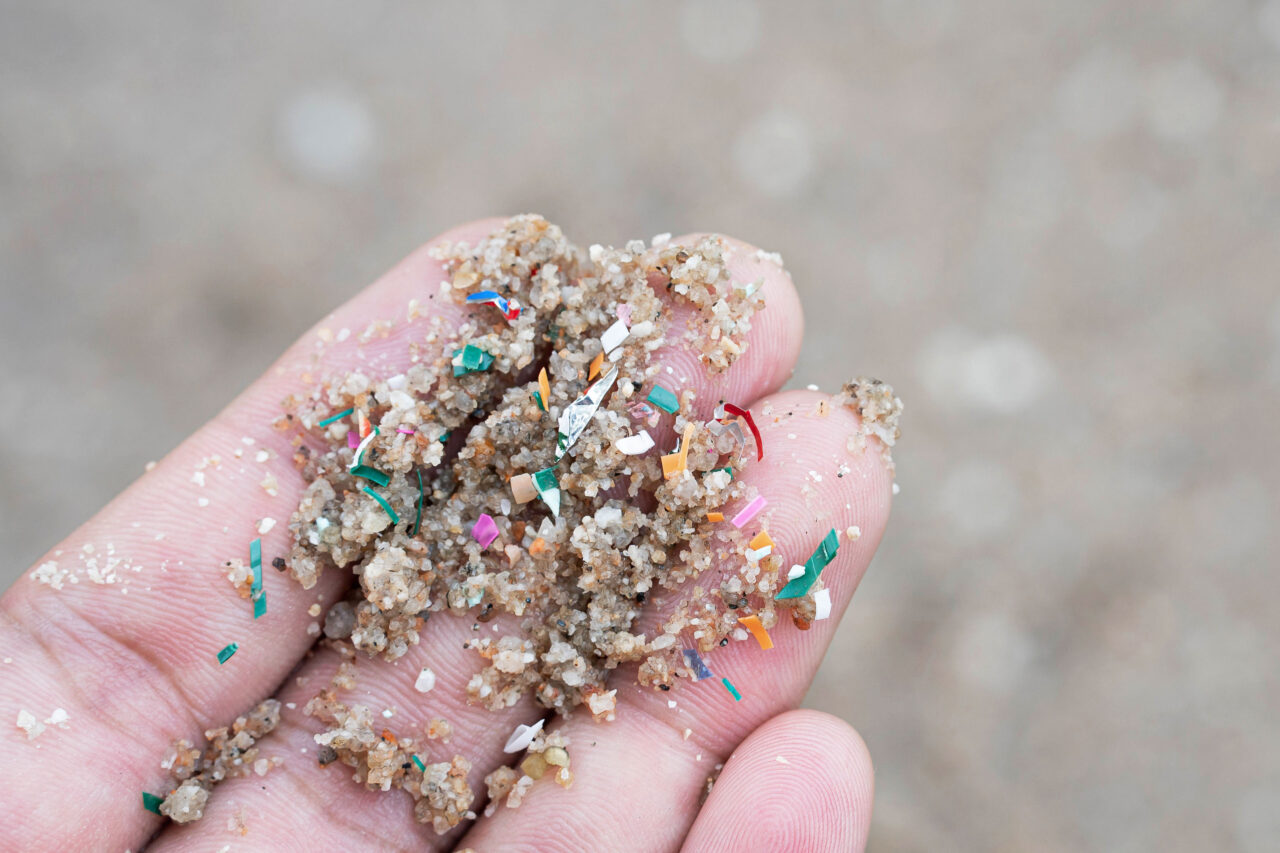
Thousands of tons of microplastics are emitted annually in the border area between Germany and Denmark. No one knows where it ends up or how dangerous it is for the environment or humans. The PlastTrack project at the University of Southern Denmark will investigate this and develop tools to combat plastic pollution in our region.
Microplastics are a problem
A year ago, microplastics were found in human blood for the first time. As many as 80 percent of 22 blood samples contained residues of one or more types of plastic. The researchers’ discovery, published in Environment International, shows that particles can float around in the blood and be stored in our organs.
Microplastics are a global as well as a local problem. Particles have been found on the surface and bottom of the deepest oceans. In the Baltic Sea, microplastics have been found in 28 percent of all fish sampled.
There are large gaps in our knowledge about where the plastic in the oceans comes from, how it degrades and where it ultimately ends up, says Professor Jacek Fiutowski from the University of Southern Denmark (SDU), who leads the consortium of six partners.
Experienced partners share their knowledge
Over the course of three years, the partners will study the degradation of different plastics and propose standard procedures for sampling micro- and nanoplastics. A database will be created to share knowledge and compare laboratory data. Each of the partners has unique competencies that they bring to the tasks.
SDU NanoSYD has the facilities and knowledge to analyze micro- and nanoparticles, while SDU DaMBIC has its focus on bioimaging and thus can contribute to spatial and chemical resolution of MNPs.
Another Danish partner is NEWTEC, an engineering company with expertise in optical sorting, fast image acquisition and image processing for industrial applications.
On the German side, GEOMAR is one of the world’s leading institutions in marine research. They use their expertise in plastics and polymer-based materials on aging, release and degradation and are at the forefront of sampling plastics from water matrices. The Alfred Wegener Institute on the German side contributes long-term knowledge in the field of microplastic analysis of water samples.
They have representatives in standardization groups, which are crucial for the project results and can contribute to new standards. CLEAN Cluster in Denmark will use its network and contribute to the knowledge exchange.
Facts and figures
The PlastTrack project has received approximately 1.74 million euros in Interreg Deutschland-Danmark funding. The project started in April 2023 and will run for three years. The project was presented to the public in Sønderborg on May 9, 2023.
Lead partner is the Mads Clausen Institute, University of Southern Denmark in Sønderborg. Other partners are DAMBIC at SDU Odense, NEWTEC Engineering A/S, CLEAN – Environmental Cluster Denmark, Alfred Wegener Institute (AWI) and GEOMAR Helmholtz Center for Ocean Research Kiel.
What is microplastics? And why is it dangerous?
Microplastics are small pieces of plastic that are less than five millimeters in size. The majority of microplastics are so small that they cannot be seen with the naked eye. Due to the movement of ocean currents, microplastics can be found all over the world.
Microplastics come from a variety of sources. When plastic somehow ends up in the ocean or nature, it is gradually broken down by water and sunlight into smaller and smaller pieces. It doesn’t dissolve, but instead becomes several smaller parts. Ultimately, microplastics become nanoplastics – and thus have the ability to penetrate cell membranes, making the material potentially very dangerous.
Want to know more?
-
Kasper Gregersen
Project manager
Tel +45 50 78 59 68
kgg@cleancluster.dk
Linkedin -
Emilie Kamuk Christiansen
Chief Project Manager (Parental Leave)
Tel +45 29 60 39 18
ekc@cleancluster.dk
Linkedin
Latest news
All news
2. Mar 2026