3D Printed Concrete Reefs with Biofilm for Healthier Harbours
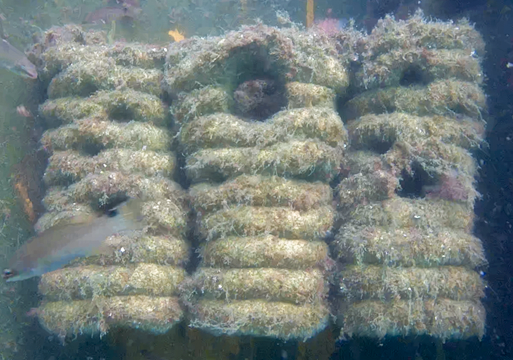
Along quays and harbour walls, the seabed is often as hard and uniform as the concrete above the waterline – and that comes at a high cost to marine life. With 3D printed concrete reefs coated in a specially developed biofilm, Stonereefs, the Danish Technological Institute and the University of Copenhagen aim to turn dead harbour surfaces into living habitats while testing new low CO₂ materials for marine infrastructure in Aarhus Harbour.
Hard harbour structures and lost habitats
Harbour environments are among the most pressured coastal areas, where pollution, dredging and hard constructions have removed many natural habitats. Smooth concrete and steel surfaces offer little space for algae, invertebrates and fish, leading to a loss of biodiversity and key ecosystem services such as water filtration and feeding grounds. At the same time, conventional concrete has a high climate footprint, and there is a need for solutions that can support marine biodiversity while also reducing the CO₂ emissions from the structures we build in ports.
3D printed concrete reefs with biofilm as a biological ‘primer’
The project develops artificial reefs that are 3D printed in low CO₂ concrete mixes with surface geometries designed to create niches, cavities and variation for marine organisms. On top of this, the University of Copenhagen adds a biofilm – a complex microbial community that acts as a biological “primer”, making the concrete surface much more receptive to colonisation by algae and other organisms. The Danish Technological Institute develops the sustainable 3D printable concrete, Stonereefs provides reef design and printing, and the reefs are tested at an established exposure site in Aarhus Harbour to generate comparable data and keep costs down.
From grey harbour walls to blue nature
The ambition is to demonstrate that 3D printed concrete reefs with biofilm can significantly boost biodiversity in harbour areas while serving as climate friendly building blocks for marine infrastructure. In the short term, the project aims to document more species, better habitats and improved local water conditions around the reefs in Aarhus Harbour; in the longer term, the vision is to scale the technology to Danish and international harbour projects as a standard solution that links low CO₂ concrete, marine ecosystem services and the emerging blue economy.
Duration
01/11/2025 – 01/06/2026
Budget
200.000
Supported by


Partners



Other projects
All projects-
Trace
Trace contributes to Denmark reaching the national climate goals within the circular economy by 2050 with a focus on…
-
ICEFIELD
ICEFIELD is a Danish innovation project working on CO₂ removal in agriculture using a nature-based solution called…
-
Ocean Valley
The Øresund region has a unique opportunity. On both sides of the sea, there are strong energy systems, industrial…
-
LogiCCS
This project aims to develop sustainable, energy-efficient maritime logistics for transporting carbon dioxide (CO2)…