23. Jul 2025
‘AI vacuum cleaner’ opens new paths for circular use of eelgrass
Eelgrass is important for the marine ecosystem. But when it detaches, it often ends up as brown piles on beaches or floating on the sea surface. Could it instead become a circular resource with business potential?
Eelgrass serves as a habitat for many marine species and can help improve the marine environment. Recently, volunteers planted eelgrass in 32 locations along the Danish coastline to support the marine ecosystem. But what happens when the eelgrass detaches?
Each year, up to 500,000 tons of dead eelgrass wash ashore on Danish coasts. Much of it decomposes, is deposited—or in some cases—pushed back into the sea. This is costly for municipalities and burdens both the climate and the marine environment. As eelgrass decays, it releases large amounts of CO₂ and returns nutrients to the water.
But eelgrass is not just a waste product. It’s a valuable bioresource with potential applications ranging from acoustic panels to insulation and upholstery. Several companies are ready to receive the material, provided the supply can be ensured—unlike today, where collection literally depends on which way the wind blows.
From beach waste to building materials, furniture upholstery, and packaging
That’s why three Zealand-based companies—BrainBotics, Søuld, and Blue Research—have partnered in a Value Chain Check through Closing Loops. The goal is to explore how an AI-based solution for collecting dead eelgrass from the water surface could be designed. And whether it holds large-scale business potential.
In the project, the startup BrainBotics leads the AI and drone development. Søuld receives and processes the eelgrass into acoustic panels, while Blue Research contributes expertise on marine bioresources and climate and environmental impact.
We met with Søren Pallisgaard, co-founder of BrainBotics, to learn more about how the three companies—through a combination of technology, craftsmanship, and sheer determination—are working to turn beach waste into a circular resource:
“Every year, large amounts of eelgrass drift through Danish waters. It dies, detaches from the seabed, and washes ashore—often mixed with seaweed, plastic, and sand. There, it waits to be collected by municipalities or local beach groups—usually at high cost and with low recycling value. But the eelgrass floating on the water is clean and fresh. We thought: why not catch it there, before it hits the shore?”
AI-trained drones guide the raft to its target
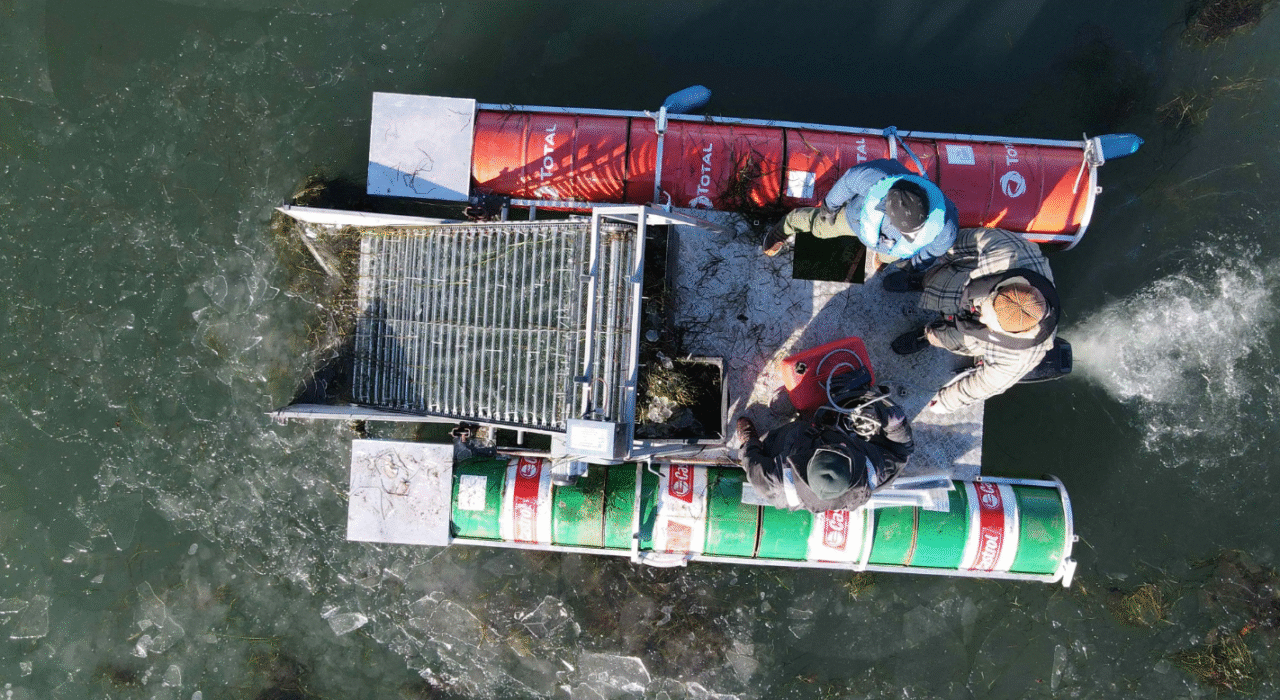
As part of the project, the partners have built a simple floating platform—essentially a raft on oil drums with a conveyor belt on board—to collect the eelgrass. But the innovation begins when the platform is paired with drones and AI. Using hundreds of drone images, BrainBotics has trained an algorithm to recognize eelgrass on the water’s surface. This enables the platform to be sent directly to where it’s needed. That’s where the real value of the technology begins:
“AI is essential for us to even find the eelgrass. It doesn’t stay put—it drifts with the current, and you can’t necessarily see it from the surface. But with the drone and algorithm, we gain an overview and can pinpoint exactly where to go to collect it. In our demo trials, we’ve proven that it works—we’ve been able to send the platform directly out and collect eelgrass exactly as predicted.”
— Søren Pallisgaard, Co-founder of BrainBotics
Collecting dead eelgrass onto the platform might sound simple, but it’s a technical challenge. According to Søren Pallisgaard, the long, tangled leaves form dense mats. This places specific demands on the angle and width of the conveyor belt used to collect it.
In the current prototype, the collection angle is adjusted manually, and even small variations can cause the belt to either grab the eelgrass—or stall. The platform’s capacity is also limited and currently requires multiple people to operate the motor, belt, and drone. These insights are now being used to develop a more efficient, semi-automated solution that can be operated by a single person via iPad.
A drone locates the eelgrass, and a specially developed platform sails out and collects it directly from the sea surface. The solution, developed by three companies with support from Closing Loops, could pave the way for using eelgrass as a raw material in everything from furniture to packaging. (Video: BrainBotics)
Security of supply is key to circular business potential
Currently, eelgrass is not collected systematically—and only after it washes ashore. By then, it is often mixed with sand, plastic, and seaweed, significantly degrading its quality. Much of it ends up as waste or in biogas plants, where high salt content and impurities often render it unusable.
This project shows that far greater value can be unlocked by collecting eelgrass while it is still clean and floating on the sea surface. Both the quality and quantity are higher—and with AI as the key technology, it’s possible to locate it with precision.
In this context, the dead eelgrass is seen as a bio-commodity with broad circular potential. Partner Søuld already uses eelgrass to produce acoustic panels and is also exploring its use in insulation. Eelgrass also shows potential in upholstery, bio-composites, and packaging—for example, as a natural alternative to bubble wrap in gift boxes and specialty packaging for wine and beer.
But to make eelgrass a truly circular business, supply security is critical. Companies cannot invest in new products or production lines without knowing if—or when—the raw material will be available. This is where the project demonstrates how technology can help create a systematic and predictable supply—rather than one that depends on weather and tides.
According to Knud Tybirk, Program Manager at Closing Loops and Senior Innovation Manager at Food & Bio Cluster Denmark, the project is a concrete example of how circular thinking and technology can go hand in hand. It’s not just about removing something unwanted from the coast—but about turning a challenge into a resource:
“Live eelgrass is hugely important as a ‘nursery’ for juvenile fish, while dead eelgrass has been a bioresource that has proven difficult to utilise. This is a tangible example of how we can reduce a municipal waste issue, clean the marine environment, and create circular business opportunities. These are exactly the kinds of solutions we aim to test and develop through Closing Loops.”
— Knud Tybirk, Senior Innovation Manager, Food & Bio Cluster Denmark
The project also highlights the challenges of working across value chains. Companies have different starting points, financial situations, time constraints, and priorities—which can complicate collaboration. According to Knud Tybirk, public programs like Closing Loops play a vital role in providing both support and structure to help new circular solutions succeed:
“As a society, we need to push for a development that takes root in the real-world operations of the many small and medium-sized businesses that make up the majority of the Danish economy.”
The prototype is just the first step
Following several successful test trials, the next step is to further develop both the floating platform and drone solution. The platform must be able to collect larger quantities of eelgrass—up to 10 tons per day. And also become more automated and user-friendly. The AI and drone monitoring will be refined so the entire system can ultimately be operated by a single person.
To achieve this, BrainBotics is now seeking funding and technical partners to help build the next version and scale the solution:
“We’ve proven that it works. Now we need to find a way to increase capacity so the solution can function with fewer hands and more automation,” concludes Søren Pallisgaard.
Value Chain Check in practice: Is there business in floating eelgrass?
- BrainBotics ApS, Søuld ApS, and Blue Research ApS have received nearly DKK 200,000 through the Closing Loops program. To explore whether a value chain can be established for collecting and reusing floating eelgrass.
- The funds were granted as a so-called Value Chain Check to assess the conditions under which a technological solution for collecting eelgrass directly from the water surface could have genuine large-scale business potential.
The article is written by Food & Bio Cluster Denmark.
Closing Loops is co-funded by the European Union and the Danish Board of Business Development.
Latest news
All news
2. Mar 2026